




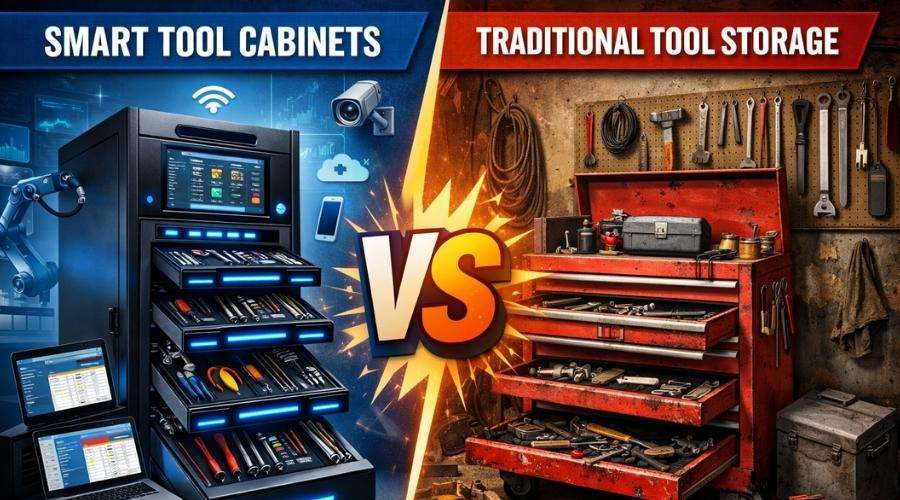
Tool rooms used to run on eyesight and memory: pegboards, labels, and a manager who “just knew.” Then tools got more expensive, teams got larger, and accountability started to hurt. Smart cabinets arrived to solve that pain with digital access control and instant inventory status.
Tool storage is not furniture. It is a control system. In this guide, we will compare smart tool cabinets with traditional storage so you can pick the setup that protects tools, accelerates work, and fits your budget. Smart cabinets add identity-based access, automatic tracking, and reporting. Traditional solutions rely on physical organization, locks, and routine checks. Choose smart cabinets when you manage shared tools, high-value kits, regulated work, or chronic loss. Choose traditional storage when your team is small, tools stay with one owner, and you need rugged simplicity
This blog focuses on what changes in daily operations when you upgrade, not on flashy features. You will learn how each option affects time on task, tool availability, replacement spend, and audit readiness.
Smart tool cabinets are enclosed storage units that manage who gets tools, when, and in what quantity. They typically use badge or PIN access, and they track tools through RFID tags, barcode scans, weight sensing, or drawer-level sensors. They can alert you when an item goes missing, runs low, or stays checked out too long.
Upgrade Your Workshop with Smart Cabinets Now
Traditional tool storage includes pegboards, wall cabinets, rolling chests, workbenches with drawers, and modular cabinet systems. These solutions organize tools physically and depend on labels, shadow boards, and human process to maintain order. Traditional tool storage cabinets can be subdivided into three categories.
Wall-mounted storage: saves floor space but limits capacity.
Freestanding cabinets: handle heavy loads but need room to open drawers safely.
Rolling toolboxes: increase mobility but can become “junk drawers” without standards.
When you compare options, start by mapping where tools live, who touches them, and how often they move. That map tells you which category fits your team and budget.
Accessibility
Start with organization and accessibility because wasted minutes compound fast. Measure time-to-find by timing ten common tools across a week, then average the seconds.
Tool Capacity and Scalability
Next, confirm capacity and scalability. Count current SKUs, estimate growth, and check load ratings per drawer and cabinet. Security comes next. Decide whether you need simple locking, user-level permissions, or full audit logs. Inventory tracking is the pivot: manual counts, barcode scans, or RFID change the labor required and the accuracy you can trust.
Build Quality
Do not ignore durability. Look at steel gauge, slide ratings, corrosion resistance, and repair parts availability. Mobility and ergonomics influence injuries and damage, so evaluate caster quality, handle height, drawer retention etc.
Finally, assess integration, power consumption, and branding because they affect adoption. Choose three primary metrics and score everything against them before you finalize your choice.
|
Feature |
Smart cabinets |
Traditional storage |
What you feel |
|
Organization & access |
App map, guided drawers |
Labels, foam, shadow boards |
Search time drops or depends on habits |
|
Security |
Badge/PIN, permissions, logs |
Keys, padlocks, sign-out sheets |
Accountability tight or informal |
|
Inventory tracking |
RFID/barcode/weight sensing |
Manual counts and audits |
Accuracy rises or drifts |
|
Replenishment |
Alerts and reorder rules |
Visual checks, reorder by memory |
Fewer stockouts or more runs |
|
Reliability |
Needs power, network, updates |
Purely mechanical |
Tech issues vs hinge issues |
|
Cost model |
Higher price, possible subscription |
Lower price, low ongoing cost |
Pay now vs pay in labor |
|
Integration |
CMMS/API options |
None built-in |
Systemized flow vs manual flow |
|
Best fit |
Shared, high-value, regulated tools |
Single-owner, low-risk environments |
Control vs simplicity |
|
Category |
Pros |
Cons |
|
Smart tool cabinets |
You tighten control fast with user-based access, timestamps, and audit logs. You expose missing tools early, which stops quiet shrinkage from turning into monthly reorders. You accelerate picking because the system guides users and flags shortages before a job stalls. You also gain cleaner replenishment cycles through alerts and usage history, so purchasing gets efficient and precise. |
You take on operational overhead. You must plan power, network coverage, user setup, and exception handling from day one. You pay more upfront and may pay ongoing subscription fees, tags, and service costs. You also carry technology risk: outages, firmware updates, and vendor dependency can interrupt access if you do not design for offline use. |
|
Traditional tool storage |
You get simplicity and durability. You install it, label it, and it works without IT support, logins, or updates. You can repair slides, swap locks, and reconfigure drawers quickly with common parts. You also keep ongoing costs low, which helps when budgets feel tight and lead times matter. |
You rely on discipline instead of system enforcement. If returns slip or labels drift, organization collapses and search time climbs. You lack a “who had it last” trail, so losses trigger debates and repeat purchases. Manual audits take time, and inventory accuracy drops between checks, which can cause stockouts at the worst moment. |
• First, write down how many people need access and whether access must be role-based.
• Next, list the tools that drive cost when they vanish or sit unavailable.
• Then set capacity targets in cubic feet and load ratings per drawer, and include growth for the next two years. Decide how you want to track items: none, barcode, or RFID, and specify the accuracy you require.
• Confirm practical constraints such as floor space, doorway width, caster needs, and power and network availability.
• Set a hard budget for purchase and for monthly fees, and include training time.
• Demand warranty terms, spare parts availability, and a support response target.
• Finally, define success metrics for the first 60 days: inventory discrepancies, time-to-find, and tool loss incidents. If a solution cannot meet your top three needs, cut it quickly and move on. You save time and buy with confidence.
Vendor choice can make or break smart storage. Start by separating cabinet builders from software providers and from integrators; sometimes you need all three, sometimes one handles everything. Ask how updates ship, how long hardware stays supported, and what happens when a component fails. Push for a live demo using your own tool list, not a canned showroom setup. For smart cabinets, verify authentication options, offline behavior, data export, and API access if you run CMMS or ERP.
For traditional storage, inspect slide ratings, steel thickness, coating quality, and parts availability. Compare warranties in writing and confirm lead times for replacements. Pricing needs structure: hardware cost, installation, subscriptions, tags, and training. Then negotiate a pilot with clear success metrics and a defined exit. If a vendor dodges details or buries fees, walk away. You are buying uptime, not a box. And you should demand proof before you scale across sites.
If you have decided on smart cabinets then make the decision with a simple sequence. First, price the pain. Estimate yearly spend on replacements, lost time, and job delays caused by missing tools. Next, decide whether accountability must be personal or merely physical. If you need to know who took what, smart cabinets earn their keep. Then check your operating readiness: stable power, network coverage, and someone who owns user setup and reporting.
If you cannot support thse additional costs, stay traditional. For traditional tool storage, commit to standards: labeled locations, return rules, and scheduled audits. No exceptions. Many teams succeed with a split model: smart control for calibrated instruments, torque tools, and high-value kits, and traditional drawers for common hand tools. Finalize your decision with a 30-day demo. Measure time-to-find, discrepancy rates, and tool loss incidents. If results move, scale. If not, fix process before buying more hardware. You will spend less, argue less, and keep work flowing smoothly.
They become worthwhile when lost tools, rework, or time spent searching exceeds the overall monthly operational and management costs.
RFID reads faster and reduces missed scans, but it needs tagging discipline and can struggle with certain metals unless tuned. Barcode costs less and works well when you can enforce scan-in and scan-out.
Most systems continue operating locally, but reporting and remote alerts are temporarily paused until the connection is restored.
Put cabinets on a segmented network, enforce unique logins, rotate credentials, and keep firmware current. For traditional storage, the “security plan” is keys, sign-out logs, and regular audits.
Tool rooms used to run on eyesight and memory: pegboards, labels, and a manager who “just knew.” Then tools got more expensive, teams got larger, and accountability started to hurt. Smart cabinets arrived to solve that pain with digital access control and instant inventory status. Tool storage is not furniture. It is a control system. In this guide, we will compare smart tool cabinets with traditional storage so you can pick the setup that protects tools, accelerates work, and fits your budget. Smart cabinets add identity-based access, automatic tracking, and reporting. Traditional solutions rely on physical organization, locks, and routine checks. Choose smart cabinets when you manage shared tools, high-value kits, regulated work, or chronic loss. Choose traditional storage when your team is small, tools stay with one owner, and you need rugged simplicity This blog focuses on what changes in daily operations when you upgrade, not on flashy features. You will learn how each option affects time on task, tool availability, replacement spend, and audit readiness. What are Smart Tool Cabinets? Smart tool cabinets are enclosed storage units that manage who gets tools, when, and in what quantity. They typically use badge or PIN access, and they track tools through RFID tags, barcode scans, weight sensing, or drawer-level sensors. They can alert you when an item goes missing, runs low, or stays checked out too long. Upgrade Your Workshop with Smart Cabinets Now What are Traditional Tool Storage Cabinets? Traditional tool storage includes pegboards, wall cabinets, rolling chests, workbenches with drawers, and modular cabinet systems. These solutions organize tools physically and depend on labels, shadow boards, and human process to maintain order. Traditional tool storage cabinets can be subdivided into three categories. Wall-mounted storage: saves floor space but limits capacity. Freestanding cabinets: handle heavy loads but need room to open drawers safely. Rolling toolboxes: increase mobility but can become “junk drawers” without standards. When you compare options, start by mapping where tools live, who touches them, and how often they move. That map tells you which category fits your team and budget. Choosing a Suitable Smart Tool Cabinet: Issues to Consider Accessibility Start with organization and accessibility because wasted minutes compound fast. Measure time-to-find by timing ten common tools across a week, then average the seconds. Tool Capacity and Scalability Next, confirm capacity and scalability. Count current SKUs, estimate growth, and check load ratings per drawer and cabinet. Security comes next. Decide whether you need simple locking, user-level permissions, or full audit logs. Inventory tracking is the pivot: manual counts, barcode scans, or RFID change the labor required and the accuracy you can trust. Build Quality Do not ignore durability. Look at steel gauge, slide ratings, corrosion resistance, and repair parts availability. Mobility and ergonomics influence injuries and damage, so evaluate caster quality, handle height, drawer retention etc. Finally, assess integration, power consumption, and branding because they affect adoption. Choose three primary metrics and score everything against them before you finalize your choice. Detailed feature-by-feature comparison Feature Smart cabinets Traditional storage What you feel Organization & access App map, guided drawers Labels, foam, shadow boards Search time drops or depends on habits Security Badge/PIN, permissions, logs Keys, padlocks, sign-out sheets Accountability tight or informal Inventory tracking RFID/barcode/weight sensing Manual counts and audits Accuracy rises or drifts Replenishment Alerts and reorder rules Visual checks, reorder by memory Fewer stockouts or more runs Reliability Needs power, network, updates Purely mechanical Tech issues vs hinge issues Cost model Higher price, possible subscription Lower price, low ongoing cost Pay now vs pay in labor Integration CMMS/API options None built-in Systemized flow vs manual flow Best fit Shared, high-value, regulated tools Single-owner, low-risk environments Control vs simplicity Advantages and Disadvantage of Both Cabinet Variants Category Pros Cons Smart tool cabinets You tighten control fast with user-based access, timestamps, and audit logs. You expose missing tools early, which stops quiet shrinkage from turning into monthly reorders. You accelerate picking because the system guides users and flags shortages before a job stalls. You also gain cleaner replenishment cycles through alerts and usage history, so purchasing gets efficient and precise. You take on operational overhead. You must plan power, network coverage, user setup, and exception handling from day one. You pay more upfront and may pay ongoing subscription fees, tags, and service costs. You also carry technology risk: outages, firmware updates, and vendor dependency can interrupt access if you do not design for offline use. Traditional tool storage You get simplicity and durability. You install it, label it, and it works without IT support, logins, or updates. You can repair slides, swap locks, and reconfigure drawers quickly with common parts. You also keep ongoing costs low, which helps when budgets feel tight and lead times matter. You rely on discipline instead of system enforcement. If returns slip or labels drift, organization collapses and search time climbs. You lack a “who had it last” trail, so losses trigger debates and repeat purchases. Manual audits take time, and inventory accuracy drops between checks, which can cause stockouts at the worst moment. Comparative selection checklist for Buying Smart Tool Cabinet • First, write down how many people need access and whether access must be role-based. • Next, list the tools that drive cost when they vanish or sit unavailable. • Then set capacity targets in cubic feet and load ratings per drawer, and include growth for the next two years. Decide how you want to track items: none, barcode, or RFID, and specify the accuracy you require. • Confirm practical constraints such as floor space, doorway width, caster needs, and power and network availability. • Set a hard budget for purchase and for monthly fees, and include training time. • Demand warranty terms, spare parts availability, and a support response target. • Finally, define success metrics for the first 60 days: inventory discrepancies, time-to-find, and tool loss incidents. If a solution cannot meet your top three needs, cut it quickly and move on. You save time and buy with confidence. How to Shortlist a Reliable Smart Tool Cabinet Supplier Vendor choice can make or break smart storage. Start by separating cabinet builders from software providers and from integrators; sometimes you need all three, sometimes one handles everything. Ask how updates ship, how long hardware stays supported, and what happens when a component fails. Push for a live demo using your own tool list, not a canned showroom setup. For smart cabinets, verify authentication options, offline behavior, data export, and API access if you run CMMS or ERP. For traditional storage, inspect slide ratings, steel thickness, coating quality, and parts availability. Compare warranties in writing and confirm lead times for replacements. Pricing needs structure: hardware cost, installation, subscriptions, tags, and training. Then negotiate a pilot with clear success metrics and a defined exit. If a vendor dodges details or buries fees, walk away. You are buying uptime, not a box. And you should demand proof before you scale across sites. Conclusion If you have decided on smart cabinets then make the decision with a simple sequence. First, price the pain. Estimate yearly spend on replacements, lost time, and job delays caused by missing tools. Next, decide whether accountability must be personal or merely physical. If you need to know who took what, smart cabinets earn their keep. Then check your operating readiness: stable power, network coverage, and someone who owns user setup and reporting. If you cannot support thse additional costs, stay traditional. For traditional tool storage, commit to standards: labeled locations, return rules, and scheduled audits. No exceptions. Many teams succeed with a split model: smart control for calibrated instruments, torque tools, and high-value kits, and traditional drawers for common hand tools. Finalize your decision with a 30-day demo. Measure time-to-find, discrepancy rates, and tool loss incidents. If results move, scale. If not, fix process before buying more hardware. You will spend less, argue less, and keep work flowing smoothly. Frequently asked questions (FAQ) Are smart cabinets worth it for a small shop? They become worthwhile when lost tools, rework, or time spent searching exceeds the overall monthly operational and management costs. How reliable is RFID versus barcode? RFID reads faster and reduces missed scans, but it needs tagging discipline and can struggle with certain metals unless tuned. Barcode costs less and works well when you can enforce scan-in and scan-out. Can smart cabinets work offline? Most systems continue operating locally, but reporting and remote alerts are temporarily paused until the connection is restored. How do you secure multiple tool cabinets in a system? Put cabinets on a segmented network, enforce unique logins, rotate credentials, and keep firmware current. For traditional storage, the “security plan” is keys, sign-out logs, and regular audits.
READ FULLBefore you compare brands. Before you debate steel thickness. Pause. The smartest tool cabinet decisions start with the workshop, not the product. Every workshop has an environment. Some have a fast-paced work environment. Others are precise and disciplined. A cabinet that thrives in one environment can quietly fail in another. The job here is alignment. Start with how work actually flows. Where do technicians move? Where do tools pile up? Where does time leak away? Tool cabinets are not storage furniture but operational infrastructure. Types of Workshops and Their Storage Needs An automotive bay lives on speed. Rolling access. Tools in motion. Cabinets must move with the technician, not force them to walk back and forth. Request a Quote Pricing for Tool Cabinet A fabrication or industrial maintenance shop is different. Heavier tools and tool changing are less frequent. Cabinets anchor stations and absorb weight without flexing or complaining. Electrical and precision workshops demand order. Here, smaller tools and easy-to-understand tool classification is vital for efficient working. Locking and layout matter more than raw size. Woodworking shops bring dust, vibration, and tools that are long in length. Drawer width and sealing are suddenly crucial for keeping tools protected and storage. In the end, you need to choose cabinets that match the workshop type. The alternative is a slowed working pace and more fatigue for staff. Tool Volume and Weight Load This is where many buyers underestimate reality. With time, tool collections tend to grow and more storage space will be needed. A tool cabinet that fits today’s tools will often limit tool expansion in the future. Overloaded drawers sag and sliding mechanisms fail. Technicians compensate by stacking tools where they don’t belong, and that is the chief source of bad organization and indiscipline. Heavy-duty tools demand durable cabinets. Real capacity is worth it only if it holds up after thousands of open-close cycles. If the cabinet flinches under weight, productivity will too. So, furnishing a workshop with tool cabinets means thinking about future needs. Available Floor and Wall Space Space is expensive. Floor cabinets dominate the space, and they store more. But they also occupy space and limit floor layout option. Mobile cabinets offer flexibility but require open paths and disciplined parking habits. The best workshops don’t just fit cabinets into space. They design space around cabinets. Key Features That Define a High-Quality Tool Cabinet Quality tool cabinets only reveal their build quality with consistent usage over time. Anyone can make a cabinet look good on day one. The real test starts after six months of continuous use, which involves slamming of drawers and overloaded trays. Drawer Load Capacity and Construction Drawers have to survive the heavier use. So their construction quality contributes a lot to a tool cabinet’s performance. This means adequate steel thickness and reinforced corners. But drawer slides matter most. Ball-bearing systems should glide under load, without any hiccups. A smooth drawer reduces strain. On tools. And on hands. And when drawers fail, everything fails. Locking Systems and Security Tools are an expensive asset. So, theft protection is a must. Central locking systems simplify control and give complete security. Individual locks offer precision where needed. Both safety mechanisms are adequate. The problem only arises if the locks are weak. That sends the wrong signal to staff and potential thieves. Organization and Modularity Mess in a workshop is not a sign of productivity but a sign of systems failure. To keep everything organized high-quality tool cabinets should have drawer size variety. Deep drawers for power tools and shallow ones for hand tools. They should feature dividers for neat arrangement of tools. Modular layouts that adapt as toolsets are also crucial. A good organization doesn’t just store tools. It speeds up decisions and sharpens focus during the job. The result is a brisk working pace. Durability and Finish Workshops are hostile environments filled with oil, dust, moisture and chemical vapours. Powder-coated surface finishes are vital to resist corrosion and keep cabinets in good condition. Edges should be reinforced. The tool cabinet should absorb daily abuse without getting damaged. Durability of the build only becomes apparent after years, when cheaper cabinets start to become noisy hinges and dragging sliding components. Top Tool Cabinet Types Every Workshop Should Consider No single cabinet does everything well. Smart workshops use combinations. Each type earns its place in modern workshops of 2026. Rolling Tool Cabinets These are the workhorses of dynamic environments. They reduce steps and keep tools within arm’s reach. In automotive and service workshops, these cabinet types make the work much more hassle-free and easier to manage. Look for cabinets that have a heavy-duty build and a secure locking mechanism. A good rolling cabinet feels like an extension of the technician enhancing the workflow. Stationary Floor Tool Cabinets When stability is non-negotiable, stationary cabinets offer an excellent option. They carry serious weight and are well-suited for high-volume workshops where tools need to be returned to the same place every time. These cabinets don’t need to move around and stay at a fixed location. Wall-Mounted Tool Cabinets If the workshop lacks squae footage wall-mounted cabinets are great. They are particularly preferred in 2026, where rents are expensive wall-mounted cabinets free the floor and sharpen organization. Perfect for compact workshops or clean environments where clutter is unacceptable. But to make this variant successful three things need to be on point. Installation matters. Load distribution matters. Done right, wall cabinets elevate efficiency. Done wrong, they become unused boxes on the wall. Tool Cabinet and Workbench Combos This is where flow tightens. Integrated workbench cabinets compress movement. Tools below. Work above. No wasted steps. No broken concentration. For assembly lines, repair benches, and maintenance stations, this setup accelerates output without adding square footage. How Tool Cabinets Improve Workshop Productivity Productivity doesn’t collapse all at once. It only becomes noticeable when in few extra steps are needed to complete a task. A few seconds searching for a tool or a misplaced wrench. This wasted time compounds over months and years and the loss becomes expensive. Well-designed cabinets shorten tool retrieval time and reduce walking time. They eliminate decision fatigue. Tools are placed exactly where they are expected to be which means faster access. Tool safety is also a productivity booster. Proper storage reduces trip hazards, tool damage, and rushed mistakes. Fewer incidents. Fewer interruptions. More uptime. Common Mistakes to Avoid When Buying Tool Cabinets The most expensive mistakes look reasonable during the buyer decision but become known later. • Buying for today’s tool count, not tomorrow’s growth. • Prioritizing appearance over load ratings. • Ignoring drawer slide quality. • Underestimating space constraints. • Chasing low price instead of long service life. Cheap cabinets don’t fail immediately. They degrade gradually and faults emerge like stuck drawers. and unstable frames. Technicians adapt in bad ways. By the time replacement is considered, inefficiency is already baked into operations. Choosing Tool Cabinets for Long-Term Value True value is not the sticker price. It’s the lifespan. A cabinet that lasts ten years costs less than one that is replaced every three. And tool cabinets that have substandard build will need more maintenance, and that means more downtime, which always cuts into profitability. Technician frustration has a cost. Long-term value comes from durable materials, proven hardware, and modular designs that adapt as workflows evolve. Buy cabinets like you are buying infrastructure with utmost attention to detail. Bulk Purchasing Tool Cabinets for Workshops and Facilities Scaling introduces pressure. Multi-bay workshops, franchises, and industrial facilities need consistency. Same dimensions. Same drawer behavior. Same durability across locations. Bulk purchasing simplifies training, replacement, and layout planning. It protects margins. It standardizes performance. More importantly, it creates predictability. And predictability is operational power. Conclusion Tool cabinets don’t generate revenue directly. But they decide how efficiently revenue is earned. They influence speed and safety. Choose them casually, and inefficiency creeps in silently. But if you decide rationally by keeping in mind workshop layout and needs Movements shorten and focus sharpens. And the result is better output. The best workshops don’t look busy. They look controlled. And the right tool cabinets make that possible. Frequently Asked Questions (FAQ’s) How do I choose the right size and type of tool cabinet for my workshop? Start with how you work, not how the cabinet looks. Count your tools. Then assume that number will grow. Fast-moving workshops benefit from rolling cabinets that follow the technician. Fixed stations need floor cabinets that hold weight without shifting. Tight spaces call for wall-mounted units. Measure your floor and wall space carefully. A cabinet that blocks movement will slow everything else. Choose for workflow first. Size comes second. What is the best material for a durable tool cabinet? Steel wins. Always has. Heavy-gauge steel resists bending, absorbs impact, and survives daily abuse. Powder-coated finishes add another layer of protection against oil, moisture, and corrosion. Thin metal looks fine early on. Then it flexes. Then drawers sag. Durability is not about shine. It’s about what holds up when the cabinet is no longer new. What are the most important features to look for in a tool cabinet? Drawer performance comes first. Smooth, full-extension slides matter more than extra compartments. Load rating matters more than drawer count. Locking systems protect tools and enforce accountability. Modular layouts allow the cabinet to evolve with your toolset. Ignore gimmicks. Focus on features that reduce strain, speed access, and survive repetition. How can I effectively organize my tools within the cabinet? Group tools by task, not by size alone. Frequently used tools go in top drawers. Heavy tools stay low. Use dividers and foam inserts to give every tool a home. If a tool doesn’t have a place, it becomes clutter. Organization isn’t about neatness. It’s about speed, safety, and control. Important Resources Toolcabinetsol About Toolcabinetsol Contact Toolcabinetsol Team
READ FULLMost people don’t give a second thought to the storage cabinet sitting in the corner of their workshop or warehouse. It’s just there, right? But the truth is that cabinets are a fixture that plays a major role in keeping an office space clean. Their ability to contain clutter is linked with the sturdiness of construction and a weak hinge, a lock that sticks, or shelves that bend under the wrong weight can quickly result in a mishap. A spill here, an accident there, maybe even an OSHA citation if the wrong inspector walks by. When you start thinking about it, the cabinet isn’t just furniture. It’s a quiet safety net. It keeps workers out of harm’s way, protects valuable stock, and saves the business from headaches nobody wants to deal with. And to be honest, the right one doesn’t just tick compliance boxes, it builds trust in the workspace. Employees feel safer, managers sleep easier, and the business avoids the kind of drama that costs way more than the price of a sturdy cabinet. Why Safety Features in Material Cabinets Matter for Businesses Every workplace carries some level of risk, and storage is often where hazards quietly build. So, safety standards for material cabinets are an absolute necessity. A can of solvent left in an unsuitable cabinet, for instance, might slowly corrode the surface until one day it leaks onto the floor. That’s more than a mess, it’s a safety violation waiting to happen. When the right cabinet is in place, accidents like that can be reduced or even eliminated. Businesses also have to think about compliance. Agencies like OSHA or standards under ISO guidelines aren’t just bureaucratic hoops, they’re protective frameworks meant to reduce harm. Non-compliance doesn’t just invite fines, it undermines a company’s credibility. Clients, employees, even auditors, they all notice when safety is taken seriously. And then there’s the long-term picture. A properly designed industrial material cabinet prevents accidents and protects products from damage thereby enhancing the efficiency of a business. Think of it this way: every small investment in a safer cabinet pays for itself many times over in terms of long run avoided lawsuits, fewer insurance claims, and smoother day-to-day operations. It’s not dramatic, but it’s the kind of quiet cost-saving that keeps a business running strong. Top 6 Safety Features to Look for in a Material Cabinet Sturdy Construction & High-Quality Materials Durability is the first thing a good material cabinet needs and the feature that counts the most towards a long service life. No one wants to open the door and feel the metal frame rattle as though it’s about to give way. The strongest cabinets have a solid construction consisting of heavy-duty steel or reinforced alloys that can stand up to years of use. They are impact-resistant remaining unaffected when equipment bumps into them and they hold up against corrosion, and in many cases, they even offer some fire resistance. When a cabinet is well-built, it does more than just store things. It provides a sense of reliability. Employees don’t have to wonder if the shelves will bend or the hinges will squeak off. That trust in equipment may sound small, but it shapes the entire culture of a workplace. Secure Locking Mechanisms What’s the point of a material cabinet if anyone can wander by and help themselves? Whether the stored items are expensive tools, proprietary components, or hazardous chemicals, keeping them locked away matters. Different businesses may prefer different types of locks. Some still rely on traditional keys, others go with digital keypads or even combination locks that don’t require a physical key at all. The right mechanism depends on the level of control a company needs. A factory floor with dozens of workers might choose electronic locks with unique access codes for tracking purposes. A smaller workshop may prefer a simpler key system. In either case, the lock itself sends a clear message: these materials are valuable, and safety isn’t optional. Fire-Resistant Design Let us think of a scenario. Suppose, A small electrical spark occurs near the storage area, the sort that would usually be nothing more than a nuisance, suddenly spreads toward flammable supplies. If the cabinet isn’t fire-resistant, the situation could escalate frighteningly fast. Fireproof coatings and insulated panels can buy crucial minutes, sometimes enough for workers to react and contain the situation before it spreads. For businesses that deal with solvents, fuels, or sensitive documents, fire resistance isn’t just a nice feature. It’s a lifeline and one of the safety standards for material cabinets. To be honest, many companies don’t consider this until after a close call. Those who do think about it early are usually grateful later. Chemical Resistance & Spill Containment Certain chemicals are notorious for their corrosive effects and if a cabinet’s surface isn’t treated properly, it might start showing rust, stains, or worse, structural weakness. premium-quality material cabinets have specially coated surfaces that resist chemical damage. But coatings aren’t the whole story. Inside the cabinet, spill containment features like trays or lipped shelving also make a huge difference. A small leak seems like a non-issue but if the cabinet is not leak-proof, the containment can spread across the floor and create slip hazard or even react with other substances nearby. Spill trays llimit the mess and make cleanup a quick and simple task. It’s one of those features that seems unnecessary until the first time it prevents a disaster. Adjustable Shelving with Safety Load Capacity Not all materials are created equal. Some are bulky while others are compact. And many have an irregular shape. To accommodate loads of various shapes and size it is a feature like aadjustable shelves is a must-have for storing without compromising safety. That said, flexibility only matters if the shelves are built to hold weight properly. When load capacity isn’t clear, employees might stack items until the shelf bows and collapses. That single failure can ruin thousands of dollars’ worth of stock, not to mention injure someone standing nearby. Cabinets with clearly defined load limits (and the construction to back them up) prevent that. This is a simple feature. It’s a straightforward feature, but one that speaks volumes about a manufacturer’s attention to safety. Ventilation Options Finally, ventilation. At first glance, a sealed cabinet may seem like the safest choice, but this section will not work if volatile materials are a part of the environment. If the cabinet has no proper outlet fumes will accumulate choking any person that opens the cabinet. The highlight of a functional cabinet design is that it offers controlled ventilation: small vents, sometimes with filters, that allow air to circulate without compromising containment. This feature suits environment that have paints and adhesives in proximity. A well-ventilated cabinet protects workers’ lungs, keeps the air fresher, and reduces the risk of unexpected chemical reactions. I mean, who wouldn’t prefer that over a sudden cloud of fumes? How to Select the Right Material Cabinet for Your Business Choosing the right material cabinet is less about ticking important features to have and more about seeing whether those features match your business operation or not. A business that deals mostly with paperwork or small tools will not need a cabinet with chemical resistance however, fire proof body would be more useful in this case. A lab handling solvent will prioritize spill containment and ventilation. It’s worth asking practical questions: What’s being stored? Who has access? What’s the worst-case scenario if containment fails? When a business owner takes the time to answer these honestly, the right cabinet almost chooses itself. One more thing to consider is scalability. A crucial question to ask is that will this cabinet still serve the company five years down the road, when operations have grown and storage needs doubled? Cabinets that are modular or expandable provide flexibility without forcing a complete overhaul later. Conclusion So, where does that leave a business owner staring at catalog or scrolling through cabinet specs online? It leaves them making a choice that’s bigger than storage. A good cabinet, the kind built with safety in mind, is an investment in people, in operations, in the whole rhythm of daily work. Sure, it’s easy to think “a cabinet is a cabinet.” But anyone who’s ever dealt with a collapsed shelf, a chemical leak, or a fire hazard tucked behind a flimsy door knows better. The features we’ve gone through: solid construction, fire and chemical resistance, secure locks, adjustable shelves, ventilation, they aren’t luxuries. They’re lifelines. And maybe that sounds dramatic, but it’s true. A safe cabinet pays for itself, not only in compliance but in peace of mind. At the end of the day, business runs smoother when safety doesn’t have to be questioned every time someone pulls open a door. Frequently Asked Questions (FAQ’s) What are the most important safety features of tool cabinets for industrial and workshop use? Safety features of tool cabinets include reinforced steel construction, secure locking systems, anti tip mechanisms, smooth drawer slides, load bearing capacity, and fire-resistant coatings for enhanced protection. How do tradesman cupboards of tool cabinets improve tool organization and workplace safety? Tradesman cupboards of tool cabinets offer dedicated compartments, heavy duty shelving, lockable doors, and ergonomic access that reduce clutter, prevent accidents, and improve overall operational efficiency. Why are safety standards of tool cabinets important for commercial and industrial environments? Safety standards of tool cabinets ensure compliance with workplace regulations, guarantee material strength, proper weight distribution, secure locking, and minimize risks related to tool storage hazards. How can businesses choose tool cabinets that meet modern safety standards and performance needs? Businesses should evaluate safety standards of tool cabinets by checking certifications, load ratings, locking mechanisms, build quality, durability, and suitability for specific industrial applications.
READ FULL